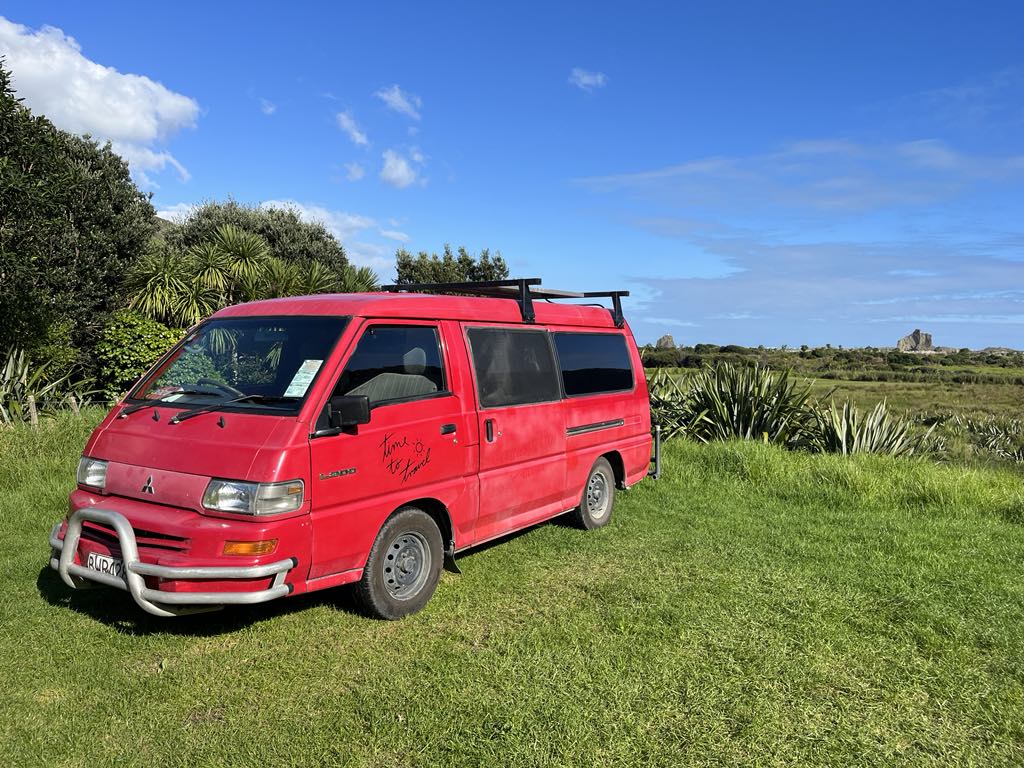
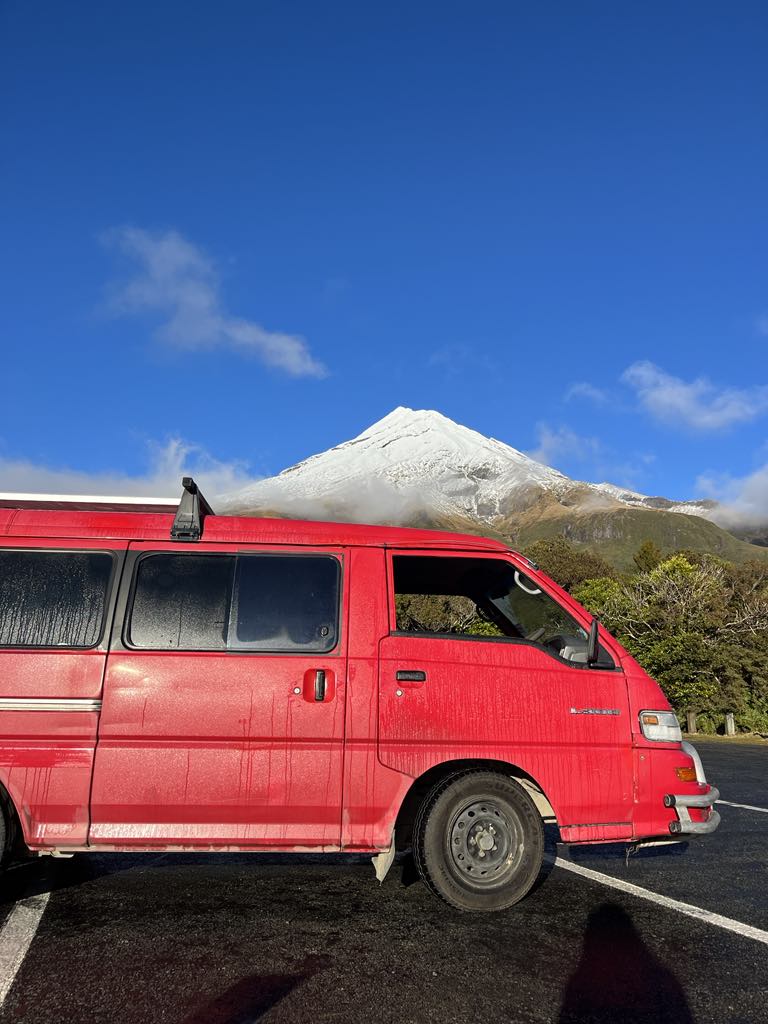
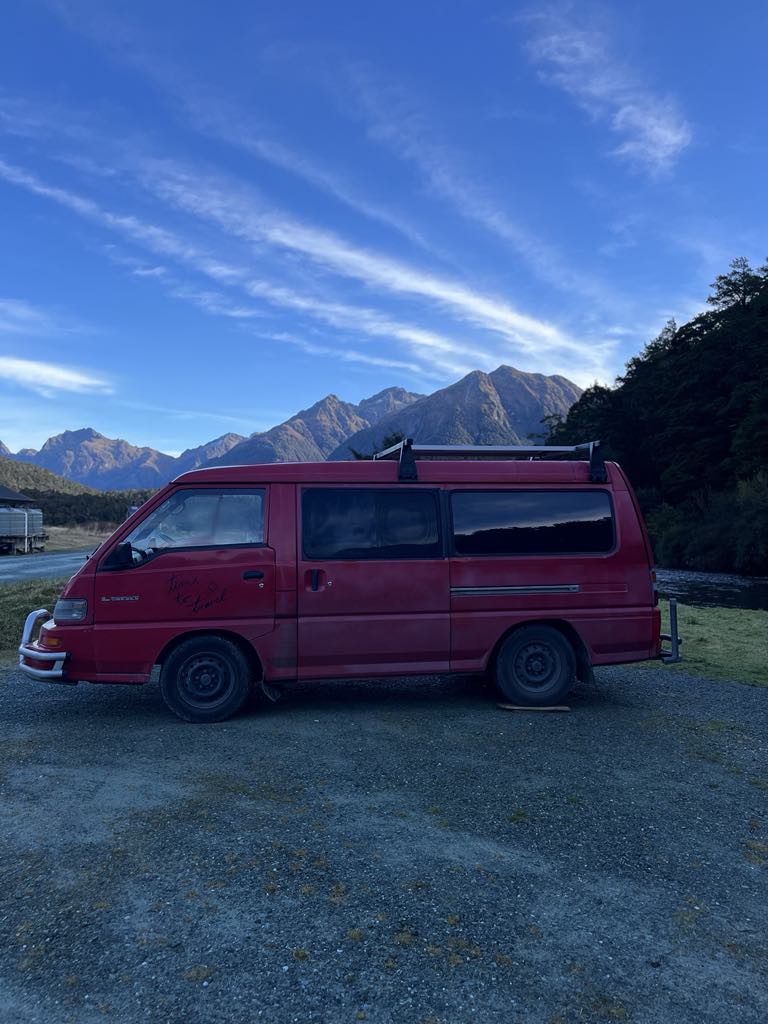
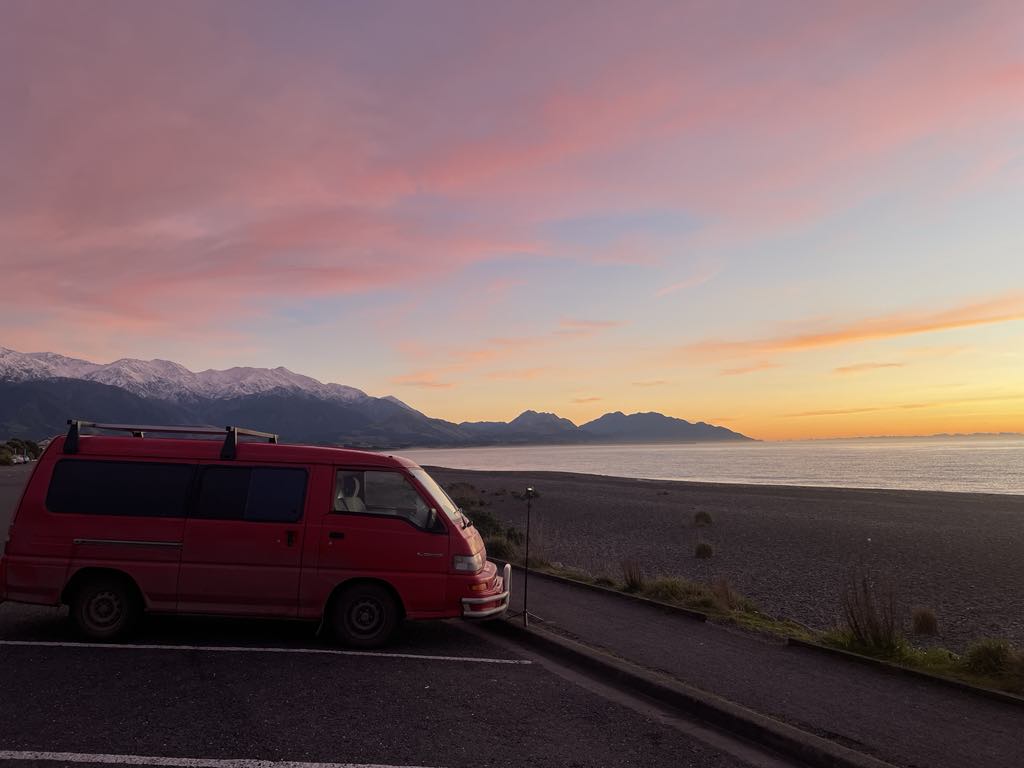
One of the never ending joys of van life is van maintenance, here in New Zealand, we have been quite fortunate (fingers crossed) and haven’t had to do any major work on The Van (Cliffjiord). New Zealand has vehicle inspections they call Warrant of Fitness, or WOF. WOF checks for the basic safety items on vehicles, like brakes, tires, and lights. For our friends in America, if you have lived in a state that has vehicle inspections, WOF is similar to that (WOF does not check for emissions). While we have been lucky with the maintenance requirements of The Van, I was pretty convinced our winning streak would have to end to get us to pass WOF. It was time to get some real work done.
Up until now, we have really just done the bare minimum, mainly only oil changes (Taylor will say this is plenty, but I stand behind the fact that it is the bare minimum). The Van has over 350,000 kms, it has been a real trooper, but things wear out, and all cars, especially old cars, need upkeep. One area of the WOF inspections which New Zealand differs from the states, is they inspect, and regularly fail vehicles, for rust. NZ says to only inspect for “structural rust”, but I have read some horror stories of people failing for body rust on a rear door, or by a back window, with the inspector stating that it could lead to structural issues. The Van is many things, but pretty is not one of them, and it has a few spots of surface rust that I was terrified would lead down a slippery slope of costly, professional, rust repairs. To mitigate this, we were determined to do what we could to fix the rust before taking it in for WOF.
Taylor and I spent a couple of nice weather days sanding ad repainting the rust spots in prep for our WOF inspection. Before we go too far, I should say that WOF should not have failed us for any of the rust spots we fixed, they were by no means structural issues, which is why we were able to fix them easily and cheaply. Thankfully, The Van does not have any structural rust issues, if it did, we would be in big trouble. This was something that I specifically looked for when we were first looking to buy a van. With that said, we still wanted to do what we could to mitigate any rust we found, not only to look better for WOF, but also to help prolong the life of The Van. After a solid afternoon of sanding, we realized it wouldn’t be quite as easy as we had hoped.
Sadly, a few of the areas were worse than we anticipated, and we had to use some body filler, or Bondo, to fill in some holes. I hate Bondo…I’ve used it a bit before but I am by no means good with it. Each time I use it, I remember why I never like doing body work. To add to the fun, we bought the cheapest paint we could find (gotta stick to our budget), and it was just barely warm enough outside that day to paint. This all resulted in some less than ideal conditions, which in turn made for some not so pretty body repairs. Regardless of all this, we kept on sanding and slathering on layers of sloppy looking Bondo, and coming back to sand it again once it had dried. Then after 3 coats of primer and what seemed like a million coats of the thinnest red paint ever, the rust was looking a lot better than it had 2 days before. Sadly, The Van will never be a show car, but we at least expect it to live a good while longer, and our rust repairs will help make that possible.
Following the rust repairs, the next obvious issue were our tires, they have served us well, but 3 would have to be replaced, one was down to cords and the other two were basically racing slicks. We shopped around a bit, again, trying to stretch our budget as far as we could, and decided we had to get used tires somehow. We ended up finding a very sketchy shop in Auckland, and after a fair amount of haggling, managed to get 3 “new” tires, balanced and installed, for $225 NZD (~$140USD). Considering our tiny little 14″ commercial grade tires generally sell for $190 NZD apiece, I was pretty happy with this outcome. Other than the shop trying to up-sell on everything, the tires themselves are in great shape and should last for a while. One more thing done.
Next, we had to make sure all our lights worked, something we should have done months ago…oops. Turns out we had a couple of running lights out, and no reverse lights. The running lights were an easy fix, one needed a new bulb, the other needed to be cleaned out – the socket was so corroded the light wouldn’t make contact. The reverse lights were a bigger issue, and after testing both bulbs, we determined it was somewhere in the wiring, sensors, or fuses. Since all other lights worked, I took a chance and didn’t even bother testing the fuse, and instead went to check the sensor. The sensor (technically a switch) is on the transmission itself, and is more or less just a toggle type switch that turns the lights on when you shift into reverse. The switch normally has two wires coming out of it; The Van’s only had one.
Now that we figured out what the issue was, we had to fix it. Even though Mitsubishi ran this exact L300 model for 30 years, the parts are pretty difficult to track down and no regular auto parts stores had what we needed. If we could order things, we could have ordered one from eBay, but that would have taken over a week to arrive from Australia, plus we can’t get mail anyway (or, we didn’t know how to get said mail, something we have since figured out). Instead, we needed to find one instore, preferably that day. We went to 4 different autoparts stores and 2 junkyards before finally finding the part we needed. It ended up being at Belair Mitsubishi*, in Takanini, which was a Mitsubishi specific junkyard, and cost us a bit more than the eBay counterparts, but we got it that day. We threw it in on the side of the road and the reverse lights were good to go. After this, it seemed like The Van was as good as it was going to get, we scheduled the WOF at a shop the Belair Mitsubishi guys recommended, and crossed our fingers.
*These guys were very helpful, they really knew their stuff when it came to Mitsubishis. If we needed parts for the L300 again I would go back in a heartbeat.
It failed. But not it wasn’t as bad as I had convinced myself it was going to be. The shop told us it failed for no horn, no license plate lights, and worn out upper control arm bushings. The horn was there, just not where they expected, and we sorted that out easily. The lights we managed to fix in a parking lot in just a few minutes. The real issue was the bushings. I was not about to try doing these in a parking lot without the right tools, or a good jack, or jack stands^, so we asked the shop to get us a quote to fix them. They quoted us at $720 NZD*, pretty steep (at least it seems it when you don’t have a job), but the van was basically useless without the WOF, we had to do it. We made an appointment for later that week.
^I did consider fixing these in a parking lot, after purchasing/renting every tool needed to do the job. While I bet this would have been the cheaper option, it also would have been the far more stressful and annoying option. As much I don’t want to admit it, sometimes it’s worth the extra money.
*The shop originally said around $1,000, but said they would try to find the parts cheaper, after a day of searching they thankfully found the parts quite a bit cheaper for us.
The day had arrived, we were going to pass WOF. We fixed the license plate lights the day before, they had a broken wire and a ton of corrosion in the sockets, nothing too hurtful. After dropping The Van off first thing in the morning, we headed to the library to wait it out, the shop expected it to be done by noon. Noon rolled around, I was a bit worried we hadn’t gotten a call. Then 2:00, no call, I was very worried. At 4:00, with still no word, we decided to walk back to the shop. While Taylor and I didn’t really say it, we were both very worried. I was convinced we would never pass WOF. The entire walk I was thinking how much money we’d lose trying to sell the van without the WOF.
We got to the shop about 30 minutes before closing, and the van still had a tire off…great. Car trouble sucks, but car trouble really sucks when you also live in that car. We stayed calm and refrained from looking up options on where to crash for the night. Eventually, the shop manager came out and said they would finish it today, they just had a few setbacks. That was a relief, but the mention of setbacks scared me, those usually aren’t cheap. The setback were that the lug-nuts broke off, he said the last guy really messed them up. We played dumb, acting like we hadn’t just had the tires replaced by the sketchiest shop in the southern hemisphere. Around 10 minutes before closing, The Van rolled out of the alignment rack and we finally were good to go. After the setbacks, the bill was $820 NZD, around $500 USD. All things considered, it could have been much worse. We paid the shop and got out of there before they could change their minds and decided that The Van needed more work the get the WOF.
After getting the WOF, both Taylor and I felt so relieved. I have always gotten anxious over car inspections, partly because my cars have always been a bit rough around the edges and usually has a good reason to fail, and The Van was no exception. A car passing an inspection has always been a cause for celebration, or thanking whoever that you got lucky, and The Van passing WOF was the perhaps the most high stakes of all the vehicle inspections I have managed to pass so far.
This was an incredibly stressful experience for us, but was certainly a cause for celebration. The WOF is good for 12 months, and will be helpful when it’s finally time to re-sell the van.

 Peaks and Places | Travel and Adventure Blog
Leave a comment